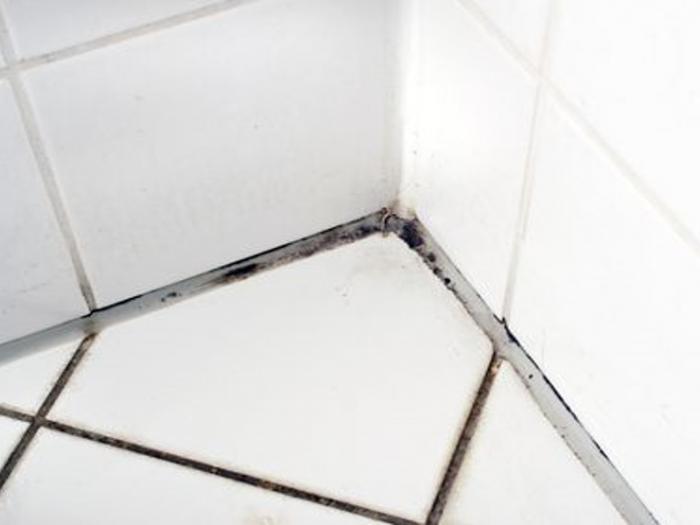
The growth of mould on sealants is a recurring event. This can be noticed by the appearance of black spots and stains on the surface of cured sealants. Not all fungi are black, but most of them are. The black spots are the result of the metabolism of mould fungi.
Once the microscopic spores arrive on a sealant joint, the spores will first absorb moisture and swell. Then, a circular thread appears which grows into a germ tissue. This tissue, mycelium, grows very quickly. At this stage, the growth of the mould fungus is limited to the organic waste materials on the sealant surface (primary mould growth). Unfortunately, elastic sealant joints such as silicones and hybrid polymers are excellent insulators as they are not thermo-conductive. As a result, these sealants are the warmest part of a tiled surface and the most suited substrate to stimulate mould growth.
What is mould fungi?
Fungi are microbes, out of ca. 250.000 known types of fungi there are ca. 50.000 that belong to the group of mould fungi. Mould fungi reproduce through microscopic spores, which are usually single cells. They distribute like dust, are very resistant and have a long life span. Because of a number of environmental conditions these fungi microbes result in what appears as black spots and stains, or mould growth, on sealants.
How does mould grow?
The environmental conditions, significantly appearing in bathrooms and kitchens, with a high influence on this recurring event are:
High moisture content and bad air circulation
Organic waste materials on the sealant surface (such as soap, body gel, kitchen garbage etc.)
Warm temperatures
PREVENTION AGAINST MOULD
It should be mentioned that good hygiene of the sealant surface will prevent the formation of this kind of contamination. Regular cleaning and disinfecting of the surfaces will keep the sealant, and all other materials in that area, free from mould.
It is impossible to prevent the presence of fungi spores in the surroundings. However, in an environment that is regularly aerated and that is kept dry, the anti-mould performance of sanitary sealants is much longer. In addition, the joint surfaces need to be cleaned regularly with a neutral cleaner and disinfected regularly with a germ-killing disinfectant.
MOLD INHIBITORS (FUNGICIDES)
Specific sealants have been developed to block the formation of microscopic spores into mould fungus. Adding mould inhibitors, named fungicides, to these sealants initiates a process that will consume the scopes and prevent mould growth as long as possible. But, the amount of fungicide in the cured sealant is decreasing over time. After some time, when the total amount of fungicide is depleted, mould may form again on the surface of the sealant. A sealant surface containing mould inhibitors will therefore remain mould-free for a longer time than a non-fungicide sealant.